Truth is, this recipe works fine for Passover too. But while I’m telling the truth – I’m frankly relieved to have done with the endless shopping, cooking, serving, and washing up that was this year’s Passover. The last stray fork is back in its box, we’ve repacked all the dishes and cookware – everything is safely stored away till next year. Now I can put the word “chometz” out of my mind for another 11 months.
And it’s springtime. Spring in central Israel lasts a couple of weeks at the most, but we’re enjoying fresh winds and a prolonged cooler-than-usual feeling. Evenings are chilly. Soup is still a good choice.
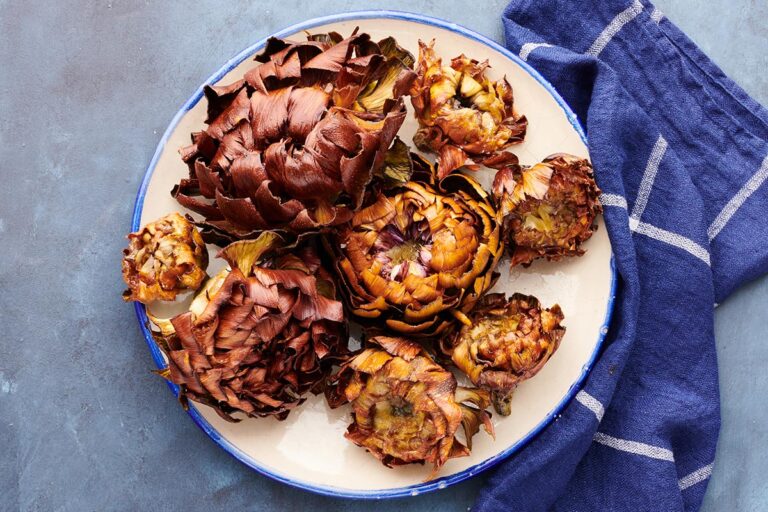
I’m a little embarrassed to admit that I made this soup with frozen artichoke hearts. Fresh artichokes have been in season for many weeks, and we have been eating them – but I had this bag of frozens…and a little basketful of mushrooms…and a craving for a simple soup. So I cooked. And it’s good – very good. The faint taste of lemon and a final swirl of butter complement the artichokes perfectly.
Artichoke and Mushroom Soup
Serves 6
Ingredients:
8-12 frozen artichoke hearts (a 400-gram bag)
1 onion, chopped
1 teaspoon salt
1 cup of chopped fresh mushrooms, setting two handsome ones aside for decoration later
3 tablespoons oil
2 garlic cloves, peeled
a pinch of thyme
2 teaspoons lemon juice – or just a hearty squeeze from a cut lemon
1 bay leaf
salt and pepper
2 cups of milk
3 scallion sprigs, chopped
6 teaspoons of butter
Method:
1. Put the oil, the onions, and the salt in a soup pan. Sauté the onions till they’re just wilted.
2. Add the mushrooms, minus the two set aside for later.
3. Add the artichoke hearts. They can go in whole – they’re rock-hard when frozen.
4. Season with salt and pepper; add the bay leaf.
5. Cook everything over medium heat for 10 minutes, stirring.
6. Add water to cover the vegetables, and the lemon juice.
7. Bring to a gentle boil, lower the flame, and simmer the soup for 30 minutes.
8. Test the artichoke hearts for done-ness by piercing one with a knife. If it’s not entirely cooked, give it another 5 minutes.
9. Remove the bay leaf. Add the thyme. Remove one whole artichoke heart and chop it into coarse dice, reserving it for later.
10. Blend the soup. The longer you blend it, the thicker it will become. But it won’t become very thick.
11. Stir the milk in. Cook for 10 minutes and taste for seasoning. Add salt and pepper to taste.
12. Put the chopped, reserved artichoke heart back into the soup. Slice the reserved mushrooms and add them.
13. Cook another 2 or 3 minutes – just long enough to cook the mushrooms through.
14. Swirl a teaspoon of butter into each bowl as you serve. Scatter chopped scallions over each serving.
Close your eyes, inhale that artichokey aroma, and eat the first spoonful. Delicious.


Shmaltz is something I make only once or twice a year, although it was the fat of choice for my Russian Ashkenazi ancestors. In the freezing winters of the Ukraine, they needed a layer of fat to keep warm. On the other hand, people were far more active physically than most of us today. They worked the calories off chopping wood for the stove, drawing well water, making and repairing everything by hand, and walking everywhere.
Every scrap of fat was precious, and not just for eating. My father told me his great-grandmother would skim all cooking fat off, keep it frozen outside all winter, and make soap from it come spring.
Goose or chicken shmaltz was also a home remedy for pneumonia. Rendered down with plenty of onions and allowed to cool, it was massaged into the chest and back of the sick one, who was then well wrapped up and kept warm. Sounds disgusting? But the onions draw out fluid and mucuous, relieving the racking cough, while the heat generated by the fat and the wrappings made the patient sweat – bringing down high fever. It was what people had, in those days before penicillin. Better to spend a few days in a fug of oniony shmaltz and hopefully survive.
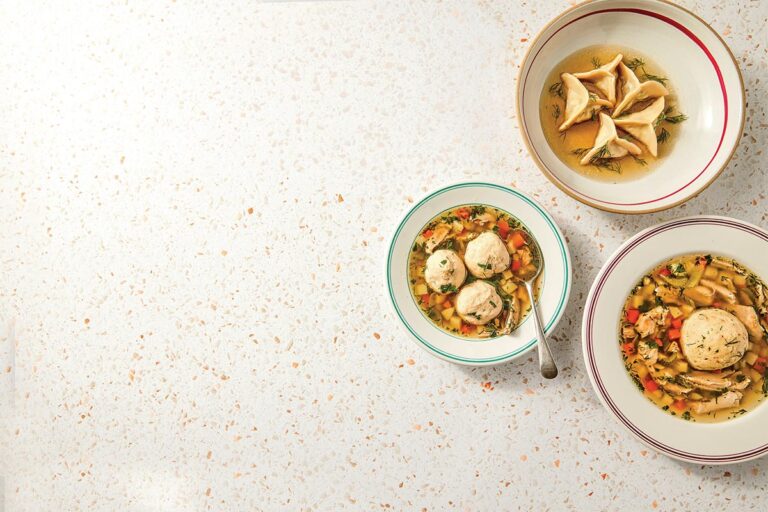
And people loved the taste of shmaltz – a shmear on bread or matzah, a tablespoon in the pan to start the cooking. We, who monitor our weight and heart health, have almost forgotten what it is. But I have a throwback nostalgia for it. I’m convinced that no other fat gives matzah balls that old-fashioned taste. So at Passover time, I take the fat off two chickens and render it down with onions. The yield is usually just enough for one batch of matzah balls.
The rest of the year, if I get a yearning for matzah balls, I use olive oil – but the taste isn’t the same.

There’s hardly a recipe. Take the raw fat and fatty skin off two or three chickens, or shnorr some off your butcher. Put it in a pan and cover it with cold water. Cook it over a medium flame till all the water has evaporated, and the skin is golden. Then chop an onion and add it to the pot. When you hear crackling and the skin and onion are dark brown, the shmaltz is ready.

Strain it, setting the chicken cracklings aside – the Yiddish name for them is gribbenis. (You can stuff matzah balls with them or add them to a kugel. Or just salt them and eat them as a guilty treat.)
Now, make your matzah balls.
Here’s the typewritten matzah ball recipe my Dad gave me, lo these many years ago: I think he took it from Jewish Cookery, adding his banana bread recipe at the bottom (the bread is obviously not kosher for Passover). It has his characteristic humorous tone. I depart a little from the recipe by adding 1/2 teaspoon freshly grated ginger.

Old-Fashioned Matzah Balls
Ingredients:
2 eggs, beaten
4 tablespoons shmaltz or other fat
1 scant cup matzah meal
1/4 – 1/2 cup water
1 teaspoon salt
1/2 teaspoon freshly grated ginger (optional)
Method:
1. Combine the beaten eggs, shmaltz, and matzah meal.
2. Add 1/4 cup water, salt, and ginger.If the mix seems stiff enough to roll into a hard ball, add more water by tablespoons till it’s a stiff batter, not a firm dough.
3. Cover the batter and put it in the fridge for 2 hours. This step is important if you want light matzah balls. The batter can rest in the fridge even longer – even overnight. It will become a dough firm enough to shape, but still a little loose in the hand.
4. Have a medium pot with plenty of boiling, lightly salted water ready. With wet hands, form walnut-sized balls of dough, and drop them in.
5. Cover and cook the matzah balls over a medium flame for 30 minutes. Lower the heat so that the water simmers after the initial boil – you don’t want the boil to destroy your little treasures.
6. Remove the matzah balls from the water and either set them aside for later or put them in your soup right away.
As Dad noted, they can be cooked directly in the soup, but don’t come out as light that way.
Nice to cook something exactly the way our ancestors did it two centuries ago. Who knows, maybe even longer?

I love Claudia Roden’s Book of Jewish Food. There are 800 recipes in it, from all the ethnic streams of Jewish life. You can almost hear Ms. Roden’s warm, humorous voice telling the myriad histories of Jews in the Diaspora and what we eat. She’s written a little encyclopedia of Jewish history and Jewish cooking.
Lately I’ve been doing a lot of cooking out of the book. So when I found myself with a whole chicken and no idea what to do with it, I opened up The Book of Jewish Food and found this recipe.
At first I thought: “Chicken soup with cinnamon?!” But I can tell you – it’s not only easy to cook, it’s really easy to eat. The rice, cooked for a long time in a rich chicken broth, gives the soup a smooth, glutinous texture that’s infinitely soothing, while the spices and lemon blend together subtly to give it character. Just that warm, exotic touch that your dinner needs on a really cold night.
Iraqi Chicken Soup with Rice
yield: 6 generous portions
printable version here
Recipe adapted from Claudia Roden’s The Book of Jewish Food.
Ingredients:
1 whole chicken
4 celery stalks, with some of the leaves, chopped
2/3 cup short-grain rice, clean and rinsed
1 small onion, chopped
1 teaspoon ground cardamom
Juice of 1 large lemon OR 1/4 preserved lemon
2 teaspoons of salt
1-½ teaspoon ground turmeric
½ teaspoon cinnamon
½ teaspoon freshly-grated ginger root, or ½ teaspoon dried, ground ginger
More salt and pepper to taste
Method:
1. Place the chicken in a large pot and add 2-¾ quarts (11 cups) of water.
2. Bring to a boil, removing any scum that rises to the surface.
3. Add all the other ingredients plus 2 teaspoons of salt.
4. Simmer 1 hour over a low flame.
5. Remove the chicken to a large platter or a chopping block. Let it cool a few minutes till you can handle it.
6. Take away the skin and remove the bones. Return the flesh to the soup pot.
7. Simmer the soup 1/2 hour longer.
8. Taste for salt and pepper; add more if needed.
Serve the soup with plenty of chicken in each bowl.

More recipes starring chicken from Israeli Kitchen:
Nut and Herb-Crusted Chicken Fillets
Garlic Chicken (or Turkey) Bites
Roasted, Fruit-Stuffed Chicken For Tu B’Shvat

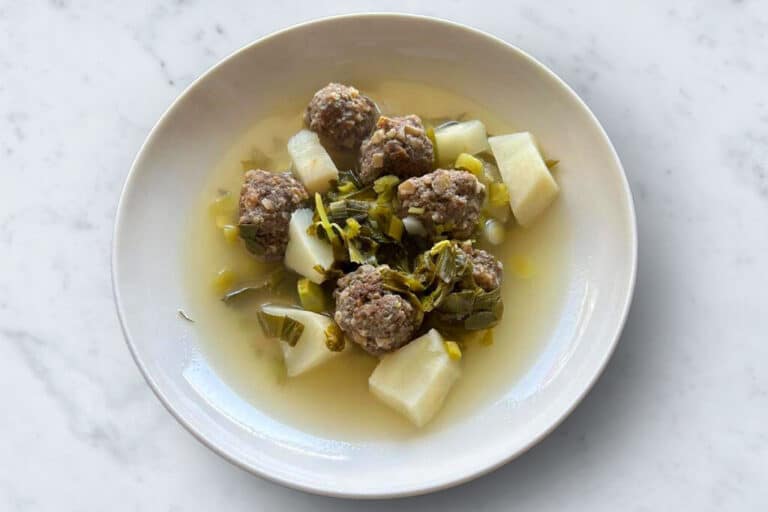
Eat it hot, and call it potato/leek soup. Eat it chilled, and suddenly you’re speaking French: vichyssoise. At this time of the year, I prefer it hot. The flavor is at once subtle and hearty: delicate leek laid over sturdy potato, with hints of vegetables from the stock coming through.
Recipes for this soup assume that you have some chicken stock on hand to use as the base. I most often do have chicken stock, but don’t use it in this soup because it wouldn’t be kosher. It must have milk and cream; chicken stock is dispensable. Make an aromatic vegetable stock instead.
It’s so easy. Here, look.
Vegetable Stock
about 5 cups
Ingredients:
1 medium onion
1 tomato
2 carrots
2 celery stalks
A few mushrooms, either fresh or dried – optional and very good. I threw in a couple of dried Shiitakes.
1 small potato
1 cup chopped zucchini or other squash (I used butternut squash)
1 garlic clove
1 bay leaf
1 tsp. salt
1 tablespoon olive oil
Water to cover the vegetables: about 4 cups
Note: wild herbs like dandelion root, nettles, mallows and purslane add lively flavor and boost the nutrition even higher. Include half a cup if you have some.
Method:
1. Scrub the potato but don’t peel it. Chop it up.
2. Peel the other vegetables except for the tomato and optional mushrooms. Chop everything.
3. Put everything, water included, in a pan. Simmer with the pan covered for 45 minutes.
4. Strain the vegetables, saving the soup.

That’s it. You won’t need all of this for the potato/leek soup. Freeze extra stock for cooking rice or enriching another soup or gravy.
Now, for de zoup.
Potato/Leek Soup (if hot), or Vichyssoise (if cold)
6-8 servings
Ingredients:
4 slender young leeks or 2 big ones: 4 cups chopped
1 medium onion
1 medium-large potato: 2 cups chopped
4 cups vegetable stock
3 tablespoons olive oil
salt
white pepper
2 cups milk
1/2 cup light cream (I use the Israeli 10%)
Method:
1. Clean the leeks. Remove the root part and most of the green top. Chop them up.
2. Peel and chop the onion and the potato.
3. Pour the olive oil into your soup pan and light a medium flame under it. Put all the vegetables in.
4. Cook the vegetables, stirring often, for 5 minutes.
5. Add the hot stock, cover the pan, and allow the soup to cook for 30 minutes.
6. Allow the soup to cool down. Use a blender to make a fine purée out of it. I use a stick blender, so it stays in the pan.
7. Add the milk and the cream. Blend again.
8. Taste for salt and pepper. Adjust seasoning (this soup needs a lot of salt), and blend again.
9. If you have removed the soup to blend it, put it back in the pan and heat it through, slowly. Stir often; don’t let the bottom burn and don’t let it boil.
10. If you prefer the soup cold, make sure it’s entirely cool and refrigerate it till chilled.
Don’t add anything else to it – no little grating of cheese, no spoonful of tomato paste, no pinch of spices. If you feel the need to decorate each bowlful, scissor some chives or scallions on. Anything else would confuse its pure, garden-fresh flavor.
My son Eliezer was about nine years old and heavily into grossing his sisters out.
“I’ll eat anything,” he boasted. “Even fish eyes.”
Eeeww. When had I ever served him fish eyes? But it caught his imagination. He strutted around talking about fish eyes, knowing he was safe. Who would ever test him on it? His friends were impressed. Wallah, that’s macho, eating fish eyes!
Then Rosh HaShana came up and I started cooking simanim. I’d never cooked black-eyed peas before, but they’re one of the traditional foods, so I simmered some up. Then I noticed how much like little eyes they looked.

Hm.
I made up a little salad with the peas, and bided. On Rosh HaShana day, we all sat down to eat and I casually put a bowlful of black-eyed pea salad in front of my boy.
“Fish eyes for you, honey,” I said. “Since you like them so much.”
He looked down at all those little white beans with the black dots, and turned green. His sisters watched, horrified. Was he really going to eat all those fish eyes? My parents, in on the joke, exchanged amused glances. He bravely poked his fork into the bowl and winced as the beans yielded.
“I’m kind of full already, Mommy,” he said. “I’ll eat them later.”
I looked at him sitting there and I melted. He was just a rambuctious little boy trying to prove himself. Finally I explained that it was really just beans. He accepted the joke with good grace, but never did eat any.
Eliezer is now 29 and says he has forgiven me, but he still doesn’t eat black-eyed peas.
I remembered this a few days ago when I was making fish soup out of the bones and heads of some fresh bass. With carrots, celery, tomato, a bay leaf, onion, chunks of potato and cilantro, it did make a rich, flavorful broth. A little drizzle of olive oil – a squeeze of lemon. Perfect.
I was pleased to have used up all the fish, even the bones, which still had some meat clinging to them. But I knew I had to remove every trace of the heads, because The Little One can’t bear to see fish heads. When she orders fish in a restaurant, I have to ask for the head to be removed in the kitchen. On Rosh HaShanah, we hide the fish head siman under a napkin.

So I took a slotted spoon and began straining out the bones. Oops. The heads fell apart, bones and cartilige separating all over the pan, and – where’d the eyes go? Oh no. There were four little boiled eyes in the soup somewhere, and I had to get them out or risk my daughter fainting at the table.
Sighing, I took up the strainer and ladled the soup into it. Aha – got one in there with all the carrot and celery pieces. Got two. Got three fish eyes, but where was the last one? I strained everything twice, poking under the vegetables with a spoon and turning every piece of fish over. No fish eye.
Well, maybe I’d already strained it out or something. It was lunchtime, and I had to get the soup on the table. I’d made a particularly savory herb bread to go with it, and the smell of fish and herbs and fresh bread was driving the family insane.
I must say, the soup was good. The Husband and The Little One served themselves seconds and sliced more bread. I looked into the pan – there was still enough for me to have seconds too. I ladled it into my bowl, put my spoon in, and sat frozen, looking into an eye.
There it was, in my bowl. I turned it over with my spoon, but it floated up again, iris side up.
Was this some kind of karmic retribution for tormenting an innocent nine-year child all those years ago? I don’t know, and I don’t care.
What I did was, I threw the damn thing out.

Aardvark Alice seems to be settling in nicely here in the Israeli Kitchen. She trots around behind me as I do housework or cook, asking questions and commenting on everything. Husband has a soft spot for all animals, but the Little One has dark suspicions about Alice. She thinks Alice takes up too much of my time and eats too much. I point out that Alice doesn’t depend on me for food – she goes out to the park at night and licks up all the insects she needs.
Although she does complain that Israeli ants taste different than those of her native savannah, and I notice that she’s joining us at dinner more and more often. Well, she has very discriminating taste – for an aardvark. Maybe the Little One feels just a bit jealous.
I mean, Alice is only little, herself.
My daughter was scornful. “She’s greedy,” she said. “She knows how to get around you. And she’s ugly.”
“She’s no oil painting,” I agreed. “But look, isn’t she sweet, really? Look at her eating her mushroom soup.” I gazed at Alice fondly; she was slurping up a bowlful in the kitchen.
“Mushroom soup,” said the Little One in disgust. “What next? Chocolate-covered matzahs, maybe? And by the way, how much is she supposed to grow?”
I looked it up online and got a shock. Alice, all pink-skinned and wrinkly and only about 4 kg. right now, is actually still a baby. When she’s all grown up, she’ll weigh as much as 65 kg. (143 lb.) and measure 1.5 meters (5 feet) in length – without her tail!
Give one pause for thought, eh? I mean…our apartment isn’t all that big.
Alice trotted in, licking her face all over with her long, sticky tongue.
“Delicious,” she said approvingly. “Would’ve been even better with some chives sprinkled over the top, though.”
The Little One shot me a meaningful look. “Anything else?” she asked.
Alice cocked her head and looked up at the Little One. “A little shot of white wine, maybe,” she said sweetly.
Mushroom Soup of the Aardvark
serves 4 humans
Ingredients:
2 Tablespoons olive oil
450 grams – 1 lb. fresh mushrooms, clean and sliced thinly. Put 4 aside for later.
1 medium onion, sliced
2 cloves of garlic, chopped
1 small potato, peeled and diced
1 bay leaf
1 cup water
3 cups of milk
2 Tablespoons white wine
1 Tablespoon butter
1/4 teaspoon dried thyme, or a sprig of fresh
salt and white pepper to taste
1/4 cup chopped chives or chopped parsley
Method:
1. In your soup pot, sauté the onions till they’re wilted.
2. Add the sliced mushrooms and the diced potatoes. Stir and cook till the mushrooms have released their juice and the potatoes are starting to get soft.
3. Add the garlic and the bay leaf.
4. Add the water. Cover the pot and cook the vegetables over low heat till they are all soft.
5. Take the pot off the heat. Either transfer the soup base to a blender or food processor, or use a stick blender, but process it till the vegetables are blended.
6. Return the blended vegetables to the pot (I just take my stick blender to the whole thing – off the heat, of course).
7. Add the milk, bring it up to a simmer, and cook for another 15 minutes. Don’t let the milk boil over.
8. Swirl the butter in. Add the wine and the thyme and the 4 sliced mushrooms you put aside, and simmer the soup another minute or so.
Spoon out some of the mushroom slices into each bowl and sprinkle chopped chives or parsley over them. Serve.

Follow me on Twitter